Clayton Preservation Project
In August of 2024, The Frick Pittsburgh embarked upon the next phase of preservation work at Clayton, the historic home of Henry Clay Frick. This project will ensure that Clayton is protected and preserved for decades to come. Follow along on social media for periodic updates on the project!
Clayton's New (Old) Color
After examining 20 years of paint layered on Clayton, we picked a fresh but more historically accurate color to repaint the house. Learn more over on the blog.
Repointing Clayton's Exterior Walls
Take a look at "repointing" — the process of removing old mortar and replacing it with new material.
Paint Removal Process
Learn more about the delicate process of removing nearly 20 layers and 150 years of paint off of Clayton!
Frequently Asked Questions
We are embarking on a multi-year project to preserve the exterior of the historic home of the Henry Clay Frick family.
YES! Clayton will remain open to the public as a museum throughout the preservation project. Guided tours of Clayton are available Tuesdays through Sundays. Advance reservations are recommended.
While Clayton will remain open, please note that the exterior appearance will be impacted by scaffolding, fencing, and other contractor activity.
- Full-scale removal of all exterior paint.
- Repair, repointing, and restoration of the exterior brick and masonry.
- Application of a Keim mineral silicate coating — a breathable but waterproof, long-lasting historic preservation “paint.”
- Repair and restoration of the exterior metal and woodwork.
- Repair and restoration of exterior windows, including storm windows.
- Repair and restoration of areas of the slate roof and flat roof.
We are prioritizing major deficiencies over less urgent repairs. Available funding will guide each year’s scope of work.
As we embark on the project, we expect to conduct the project in four phases:
PHASE 1: Northeast section (exterior wall upper levels) and select roof areas
PHASE 2: Upper cornice and select roofs
PHASE 3: Remaining exterior walls, roofs and walking surfaces
PHASE 4: Wood window repair and storm window replacement
The Frick engaged preservation architects, Perspectus, to prepare a detailed condition assessment of Clayton. That 240-page report serves as our roadmap for the project. Perspectus, together with their consultants Barber & Hoffman, Inc. and Heritage Conservation Collective, undertook:
- field investigation, testing, and analysis
- surveys conducted using a lift and images taken using a drone
- select sampling and material testing of the brick, mortar, and painted finishes
- select testing of paint removal methods
- select roofing cores at low-slope "flat" roof areas based upon analysis of infrared imagery captured from a drone
Our preliminary timeline is four years, 2024 to 2028. But, as with any old house restoration project, we are prepared for the unexpected, and will adapt the schedule if/as needed.
Following the preservation of Clayton’s exterior, we hope to make further exterior and interior improvements, including:
- improving the interior lighting
- restoring and reopening the blue bedroom on the second floor
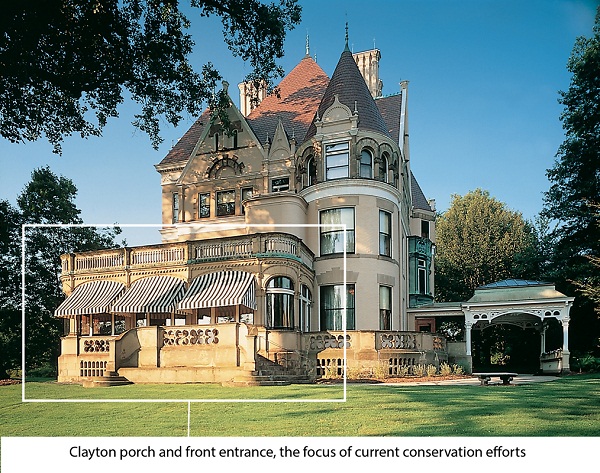 Clayton, the home of the Frick family in Pittsburgh from 1883–1905, embodies the extravagant, eclectic fashion of the Gilded Age in America and the materials and craftsmanship that exemplify that era.
 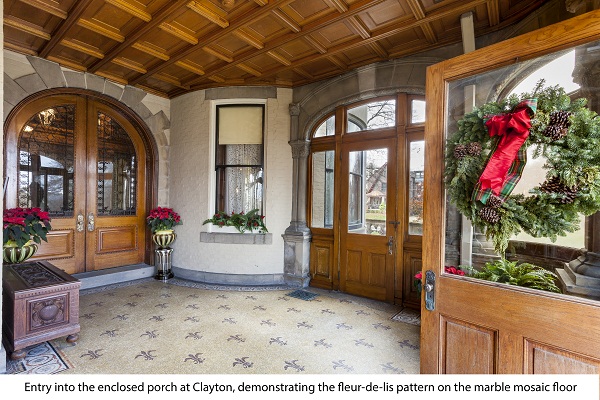 The overarching philosophy of this conservation effort is to minimize intervention into the historic surfaces and to employ a combination of historic masonry techniques, science, and innovation to preserve Clayton. The house itself is treated as an artifact, and our goal is to devise methods of treatment that counteract the effects of time and the environment on the structure and the inherent vice of the materials, systems, and techniques used in its construction. Inherent vice is a term conservators and preservationists use to describe the inevitable self-destruct mechanism in materials or combinations of materials in a system that causes them to deteriorate. To a degree, inherent vice is present in virtually all systems and materials and is a determining factor in approaches taken to maintain a building.
 .png)